
Integration & Prototyping
Turning DARE chiplets into working devices, a physical multi-node prototype and a virtual twin of a much larger machine.

At a glance
DARE devices
Chiplets integrated into System-in-Packages on PCIe cards.
Physical prototype
A multi-node machine with x86 hosts and multiple DARE devices per node.
Virtual prototype
A virtual twin of a machine about 100× to 1000× larger.
Standard interfaces
PCIe, and CXL over PCIe/UCIe.
What we are building
Integration & Prototyping turns the DARE chiplets into usable systems. Led by imec, this technical area covers the full path from chip to machine.
DARE devices – Physical design of the chiplets, design of the substrate and silicon interposer, System-in-Packages for chiplet integration, PCB design and fabrication, and bring-up and characterisation of the boards.
Physical prototype – A multi-node machine in which each node houses a standard x86 host and multiple DARE devices, integrated as PCIe cards.
Virtual prototype – A virtual twin of a multi-node machine around 100× to 1000× larger, built as a parallel discrete-event simulation (PDES) multi-fidelity model. It integrates models of the DARE devices with the required interfaces, such as PCIe and CXL over PCIe/UCIe.
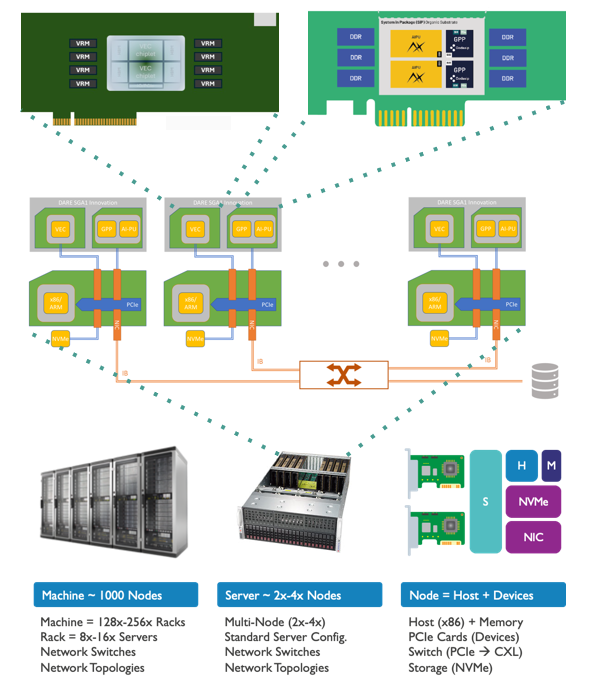
The form factor of the devices, the physical prototype and the virtual prototype are shown for illustration and will be finalised in the System Architecture Definition phase.


